Why Asset Intelligence Matters
Improved decision quality for safer buildings and better outcomes for your estate.

Why Asset Intelligence is essential for modern building management
Buildings rely on accurate and accessible information to stay safe, compliant and efficient. Yet for most organisations this information is scattered, outdated or missing entirely. Asset Intelligence matters because it fixes this. It gives the people responsible for buildings, from estates teams to strategic leaders, access to trusted information for improved decision quality.
Without Asset Intelligence, teams spend time searching for documents, reconciling conflicting data or working from assumptions. With Asset Intelligence, the information they need is available, reliable and ready to support safe and efficient operations.
Closing the Performance Gap
Asset Intelligence matters because it closes the Performance Gap. This is the persistent gap between what organisations hold about their buildings and what they can confidently act on.
The Performance Gap exists because:
- Information lost at handover
Data produced during design and construction rarely arrives in a form that estates teams can use. High‑quality digital handovers can be overwhelming and often misaligned to operational needs. - Information fragmenting through operational life
Fit‑outs, refurbishments, equipment changes and FM transitions slowly degrade information quality. Without governance, different versions of data appear in different systems and trust erodes. - Information never created for older buildings
Large parts of the UK estate pre‑date modern digital standards. For these buildings the problem is not poor information, there’s often no structured information at all. - Information that’s buried in the volume
Information that is there, correct and complete, but cannot be found by the people who need it.
Asset Intelligence gives organisations a structured way to fix each instance of the Performance Gap and prevents it from being recreated.

Reducing safety risk and strengthening compliance
Safety information is often the hardest to find. When teams need access to fire stopping details, isolation points or safety‑critical records, seconds matter. Asset Intelligence ensures this information is structured and accessible so it can be used when it counts.
This reduces safety risk, supports Golden Thread obligations and gives accountable people confidence that evidence is complete and current.

Reducing cost and avoiding waste
Without reliable information, organisations overspend on surveys, operational resets and unnecessary investigations. FM transitions often start from scratch because incoming suppliers cannot trust existing records. Capital budgets are used inefficiently because investment decisions are based on assumptions.
Asset Intelligence reduces cost by:
- Eliminating duplicated surveys
- Preventing recurring data gathering
- Supporting planned rather than reactive maintenance
- Enabling evidence‑based capital planning
These savings accumulate year after year.

Improving decision quality across the estate
Good decisions rely on good information. Asset Intelligence provides the structured data needed for:
- Prioritising maintenance
- Assessing whole‑life cost
- Planning investment
- Understanding condition and performance
- Benchmarking buildings across a portfolio
This gives leaders confidence that decisions are grounded in evidence, not gut feel or outdated records.

Enabling environmental and performance outcomes
Environmental performance, carbon reduction and sustainability reporting all depend on accurate asset information. Without structured data, organisations cannot track what equipment is installed, how systems perform or where improvements are needed.
Asset Intelligence supports environmental goals by:
- Connecting design intent to actual performance
- Informing energy and carbon decisions
- Validating the impact of upgrades
- Enabling reliable measurement against targets
This is essential for organisations with net‑zero commitments.

Strengthening operational efficiency
Operational teams work faster and more effectively when they can find the information they need without hunting through folders, systems or emails. Asset Intelligence makes information accessible to non‑specialist users so they can resolve issues quickly and work with confidence.
This reduces friction, delays and dependency on specialist knowledge.

Building resilience and organisational continuity
Information should outlast the people and suppliers who create it. Asset Intelligence ensures that knowledge does not walk out of the door with a contractor or retire with a member of staff. It creates a governed, structured and transferable record that supports long‑term estate continuity.

A foundation for every other digital investment
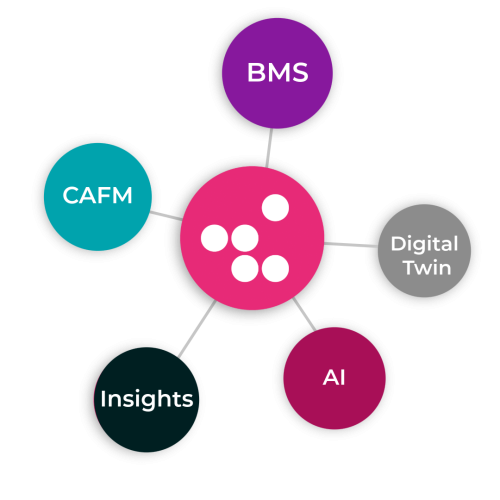
Asset Intelligence is the information layer that makes other technology investments work:
- CAFM needs accurate data to schedule work
- BMS needs context to interpret real‑time readings
- Digital twins need validated structured data to deliver insight
- Analytics and AI need reliable inputs to generate value
Without Asset Intelligence, these systems automate guesswork. With it, they accelerate performance.
Why organisations choose Asset Intelligence
Asset Intelligence matters because it delivers value in four clear ways:
- Risk reduction through stronger compliance and safety information
- Cost avoidance, including productivity, by eliminating duplication and wasted effort
- Decision quality and speed through structured, validated asset information
- Outcome achievement across environmental, social, safety and economic goals
This is why Asset Intelligence is becoming a strategic priority for asset‑intensive organisations.