What is Asset Intelligence
The discipline that ensures the people responsible for buildings can find, trust and act on the information they need to keep buildings safe, compliant and performing.

A simple explanation of Asset Intelligence
Asset Intelligence is the discipline that connects a building’s physical reality with the decisions made about it. It gives people responsible for buildings access to accurate, structured and current information in a form they can use. Asset Intelligence supports safer operations, improved compliance and higher‑quality investment and operational decisions
Many organisations already hold most of the information they need. The problem is that it is often lost, fragmented, buried or was never created. Asset Intelligence solves this by determining what information is needed, structuring it and governing it across the full lifecycle so it can be trusted and used with confidence.
Why buildings need Asset Intelligence
Across most estates, the information needed to manage a building rarely exists in a usable form. This is especially true for buildings that are older. It is common for vital information to be scattered across systems, stored in outdated formats or locked inside specialist tools that only a few people understand. This creates risk and slows down every decision.
The result is a persistent gap between what organisations believe they know about their buildings and what they can actually act on. We call this the Performance Gap. It happens in fourways:
- Information fragmenting over time as changes, refurbishments and FM transitions erode accuracy.
- Information that was never created because older buildings pre‑date digital information standards.
- Information that’s buried in the volume and cannot be found or trusted when needed.
- Information lost at handover when design and construction data never makes it into operations.
Asset Intelligence closes this gap by providing the discipline and structure needed to build a reliable information foundation.

The five functions of Asset Intelligence
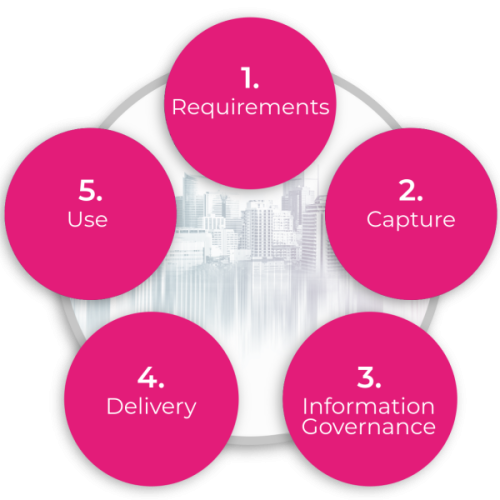
Asset Intelligence is practised through five core functions. These functions describe how information is determined, captured, governed, delivered and used so it remains accurate and actionable throughout the building lifecycle.
- Determine what information is needed – Most organisations have never defined their information requirements. Asset Intelligence begins by making those needs clear.
- Capture structured information correctly – Information produced during construction or recovered from an existing estate must be structured for operational use.
- Govern information with clear accountability – Information only stays accurate when someone is responsible for its quality, currency and accessibility.
- Deliver information to the people who need it – Information has no value if teams cannot find it quickly or understand it easily.
- Use information to decide and act – Structured information supports safer operations, improved compliance and higher‑quality investment and operational decisions.
These five functions describe how Asset Intelligence works in practice.
Asset Intelligence in practice
Asset Intelligence works by creating a structured and governed information layer that sits beneath the systems organisations already use. It is the foundation that makes technologies like CAFM, BMS, IoT platforms and digital twins reliable and effective.
Asset Intelligence does not replace these systems. It makes them work better by giving them accurate, current and validated information to draw from.

Why Asset Intelligence is different to existing approaches
Many organisations invest heavily in technology but still struggle to find or trust their asset information. This is because no existing tool or category manages information across the full lifecycle of a building.
- CAFM manages work orders but does not create or govern asset data
- CDEs manage project information but rarely extend into operations
- Digital twins depend on data quality they cannot create
- O&M systems support a single moment at handover
While international standards increasingly describe whole‑lifecycle information processes, Asset Intelligence provides the discipline, methods and governance needed to make those processes achievable in practice at estate scale.
Asset Intelligence fills the gap between these systems and standards. It ensures that information is accurate when it is created, stays accurate through decades of change and remains accessible to the people who need it.
Why Asset Intelligence is essential
Asset Intelligence matters because the stakes are high. Poor information leads to higher costs, higher risk and poorer outcomes. With Asset Intelligence:
- Compliance becomes easier to evidence
- Operational teams work faster because they find information quickly
- Maintenance becomes planned instead of reactive
- Investment decisions are grounded in real data
- Performance targets and sustainability commitments become achievable
Asset Intelligence is no longer optional. It is a requirement for modern building management and is increasingly reflected in national standards and regulations.
Additionally, as information standards evolve to describe whole‑lifecycle processes, Asset Intelligence provides the discipline and methods needed to make those processes achievable at estate scale.
Progressive confidence
Asset Intelligence operates on the principle of ‘progressive confidence’. Organisations do not need to achieve perfection on day one. They start from their current position, improve progressively and build confidence in their information over time.
This approach removes the pressure to fix everything at once. Teams can focus on the areas that matter most first, strengthen individual functions as priorities demand and expand capability as confidence grows. Progressive confidence makes Asset Intelligence achievable in practice, even across large and complex estates.

How Glider supports Asset Intelligence
Glider enables Asset Intelligence by providing the information management platforms and services required to determine, structure and govern asset information. We support organisations through:
- Digital handover services when information is created during construction
- Asset information management services for ongoing operations
- Information management services to maintain accuracy over time
- Intelligent information management software
Together, these help you create an information foundation that supports your estate for its entire lifecycle.

Turning Asset Intelligence into better outcomes
Asset Intelligence enables organisations to reduce risk, avoid unnecessary cost, improve decision quality and achieve better outcomes across safety, sustainability, performance and long‑term value.
Ready to discover more about Asset Intelligence?
Our customers